What are meaningfulconnections betweenMA Innovative Fashion Production (MA IFP) students and students from other MA courses within the School of Design and Technology, and do they increase the students’ feeling of belonging to the UAL community?
Blog Post 1: The Research Question’s Journey
I settled on this latest version of my research question because I found that by addressing this question, subsequent design for facilitating activities or learning materials can be more targeted to the students’ needs based on the findings. Further, the question is not too limitingnorhas it been asked before within the stated context. Lastly, it allows to be addressed within the given time frame of the action research project. According to the ARP teaching team resource (2025), these are features, that make up a good research question.
By maintaining a curious mind about the research question, its importance highlighted by White (2009), I adjusted the research question throughout the first 7 weeks of the project until I started the question planning for the focus group, which were customised to finding a breadth of perspectives to the research question.
Initial flaw no 1
Without realising, I assumed that the students all wanted to connect to other MA students because of the question posed in the student survey. However, the student survey result does not elicit why they wanted to connect to other MA students. What I assumed was that, like me, a recent student on the same course, they would be interested to meet other MA students with a similar topic or an overlap of interest. Without knowing why, without knowing their motivation the intervention design was informed based on my own motivation and ideas of how to possibly approach it. I realised I was jumping ahead. I wanted to create a workshop with the assumption that I know what students wanted.
Initial flaw no 2
I didn’t realise that not everyone relates belonging to having a healthy network of people. For me, this was so clearly correlated based on my own life experiences that, again, I jumped ahead to assume that this link should be obvious. I was neither able to explain it well enough nor had I evidence for this claim.
This came to light when I presented my research question and rationale during the first tutorial to my academic practice peers where I was given feedback by one peer that they couldn’t see how networking relates to increasing students feeling of belonging. “How does a feeling of belonging come from a network?” They saw it as two contradictory ends, non-related.
Consequently, I reconsidered my approach. I didn’t know what my students’ ideas and thoughts about networking were. Are their preconceptions, from a student cohort of International Asian only, the same that we have in the Global West? What is their idea of a meaningful network? What do they seek? This made me think and rephrase my research question to investigating what meaningful connections are to them and what it would take for them to think back to their study time and have a sense of belonging to a student community.
Fig. 1 My notes: development of the research question (2025)Fig. 2 The iterations of my research question 1-4 (2025)
References
Bell, J. (2010). Doing Your Research Project: A Guide for First-time Researchers in Education, Health and Social Science. 5th ed. Maidenhead: McGraw-Hill Open University Press, p. 30. Available at: https://www-vlebooks-com.arts.idm.oclc.org/Product/Index/155387 (Accessed: 16 November 2025).
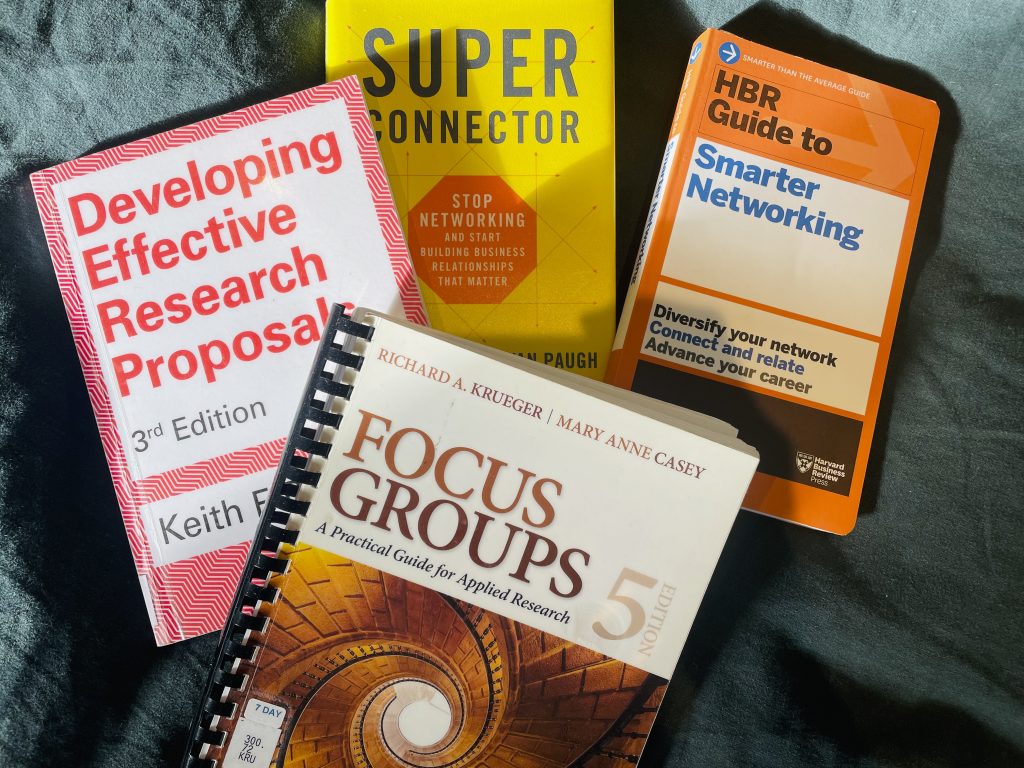
Punch, K.F. (2016). Developing Effective Research Proposals. 3rd ed. Los Angeles: SAGE, p. 47. ISBN 9781473916388.
White, P. (2009) Developing Research Questions. London: Palgrave Macmillan.
Reading Notes
Above left to right: Reading notes on Bell, J. (2010), p.30
This action research project wants to find out what the needs of MA Innovative Fashion Production (MA IFP) students are to make meaningful connections to other MA students. The results should inform the development of an intervention, such as a workshop or teaching material, that aids students to identify their individual relationship-building needs. The purpose is to foster belonging and to challenge the structural and social barriers that international students, especially those arriving from Asia, might face but may not initially recognise.
Connect – You and your connections, centres students’ needs to make meaningful emotional and professional connections during their study. It responds directly to data from our Course Student Survey (CSS, 2025), where 73% of students agreed there are sufficient opportunities to connect with other postgraduate taught students. Although a figure 10% above the UAL-wide average (see fig. 1) it still leaves room for improvement.
All current MA IFP students are Chinese, far away from home, thus the groups they belong to, such as kin, culture and friends, are not in practical, immediate reach. I believe that the lack of feeling connected and consequently to belong, negatively affects academic performance and social life, triggering a cycle that can amplify individual struggles.
“Humans are hardwired with the desire to belong; belonging to family, a group of people, a community. It is existential for us now and historically.” (Eastwood, 2022).
Our corerelationships, the people we choose to surround ourselves with, are our network and the place that we think of as belonging to. “Not to belong affects our physical and mental health. Even the fear of not belonging triggers a physical reaction and puts us into a fight and flight state” (Eastwood, 2022).
Unfortunately, the term networking has fallen into disrepute because the old doctrine encouraged practices that are self-serving and opportunistic, such as valuing the number of connections more than their quality (Gerber and Paugh, 2018; HBR, 2022). However, network building based on authenticity and reciprocity is not only effective for succeeding well in life, but promotes our well-being, as more recent studies suggest (HBR, 2022; Eastwood, 2022). I believe that having an authentic, meaningful, reciprocal, slowly and naturally grown network is directly related to our sense of belonging.
My positionality as a fairly recent immigrant to the UK, who has lived in multiple countries and speaks several languages, informs this perspective. I know first-hand the emotional importance of belonging and its correlation with having an authentic, supportive network, grown out of authentic curiosity and informed by reciprocal interest in one another. Truly diverse networks do not distinguish between private and professional; connections are often interlinked (i.e. multi-flex ties) and bridge across groups.
Reading notes: Super Connector by Gerber and Paugh (2018), from left to right p.1, p.2, p.9 with my annotations (2025)
Blog Post 2: Reflections on Connecting and Belonging
Here, I will pick up on the the previous post, by extending my thoughts on flaw number two, the perception gap about aligning connecting (networking) to belonging. My critical friends, or using a term McNiff (2020, p.22) offers “validation group”, were pointing out the following.
One peer said that to them, the correlation between having a network and experiencing a sense of belonging is not clear. Therefore, I’m asking myself “Why is it clear to me that networks are linked to belonging?” In addition, their association with networking were quite negative. Later, when I revisited the feedback, I recognised this from one of my readings in which the perception of them is described as “[reeking] of being inauthentic and of being manipulative” (HBR, 2022). Is there a bad and discomfortable connotation with networking? Is the connotation different for networks?
Contrarily, another peer perceived my project rationale more aligned with my intent, which they described in their words, “Allowing people to find their people”, which echoes one way I think of them. However, they continued, that initially, when they first heard about the idea in the previous unit, they also had perceived the project’s idea to be primarily career advancing.
“Allowing people to find their people“
PgCert peer (2025)
I clearly did not communicate the idea and link to sense of belonging well enough, at least not verbally. However, given my summative assessment feedback from the previous unit, I did a much better job at communicating the project in my writing, in which I was able to highlight the connection to my lived experience. Admittedly, I still struggle to bring myself in and it is not quite clear to me why exactly, maybe because I feel too exposed, too vulnerable; I fear to not express myself comprehensively and might be subject to misjudgment. Nevertheless, I will try and overcome my reservations, as I clearly see the benefit and I very much enjoy to listen to others share their personal story in connection to their work.
Lastly, my tutor wondered if I could reframe networking to be more natural and thus developing inclusivity further. He suggested to explore: Alone together by Sherry Turkle. This led to inspiring discoveries of more dimensions that I could consider, such as contemporary use of online networks versus in-person conversations and another was that reliance on peer’s advice diminishes self-reflection. What might be implications for my student group? I have started to integrate some insights, in particular, into considering the wording I use moving forward, such as ‘meaningful’ and using ‘connecting’ rather than ‘networking’(HBR, 2022).
Blog post 3: Reflections about the opportunities of Focus groups
References and reading notes
Research Methodology
The research methodology chosen for this project is an action research methodology (McNiff 2020, Costello 2003). Qualitative, iterative and reflexive. My approach to action research, from the many highly debated ones (McNiff, 2002, p.5) here is theory led (Costello, 2003) and self-reflective (McNiff, 2002, p.6). Although, the mixed approach was considered, but due to time constraints, the theory led approach dominated this unit’s strategy, for which I implemented guidance from literature alongside my reflective practice. The action research methodology embeds reflexive practice, both into my researcher-self and my work. This project draws on the works by Schön (1983), Kolb (1984), Gibbs (1988) and Rolfe (2001) for reflective writing practice. Writing and thinking (Freire) will be used to identify shortcomings of or gaps in the research question and rationale (Punch 2016; Bell, 2010). Similarly, the reflective process assists to evaluate findings and for making forward-looking plans.
After reviewing the issue in my current practice and identifying the aspect I want to investigate by defining the research question and rationale, I chose a data collection tool for trying out my “imagined way forward” (McNiff, 2002, p.10).
Data collection tool
The focus group interview is both my intervention and my data collection tool. This method was chosen because:
I am looking for a range of opinions, perceptions and ideas about how students may connect meaningfully to other master students.
I seek to uncover factors that influence opinions and motivation of students to want to connect to other students? *1
I am looking out for ideas emerging from the group.
According to Krueger and Casey (2000, p.21,21), a focus group is a suitable choice for investigating the aspects listed above, such as looking for different perceptions, uncovering factors for motivation, and emerging ideas, alltogether for gathering rich qualitative data.
“A group possesses the capacity to become more than the sum of its parts, to exhibit a synergy that individuals alone don’t possess.”
(Krueger and Casey, p.22)
A focus group is a qualitative research method, in which – unlike in interviews – the conversation happens amongst the participants (Krueger and Casey, 2000, p.21/22).
The screener (a set of parameters or questions to select participants) includes current MA Innovative Fashion Production students who just started their course (Year 1). This group has a similar level of expertise which contributes to creating an environment among the students where all feel comfortable and at ease to share what they think. The session will take place on the 10th floor in the LCF canteen at the end of their day overlooking the citylights in the dark to contribute a relaxed athmosphere. I am aware that as their teacher and assessor my presence might be creating an undesirable power differential, potentially influencing their responses.
Data from reflective practice will be recorded using physical journals, my Notes app and reflective annotations in my reading notes. This data will be used for further exploration of the topic and analysis.
Data Analysis Tools
The analysis of the data from the focus group is qualitative and should be systematic, verifiable, sequential, and consequential (Krueger, R.A. and Casey, M.A., 2000, p.139).
The data analysis is purpose-driven, which means to avoid being overwhelmed by the breath of insights gained, I will identify the data that directly provide insights enlightening on the research question. A continuous analysis, a quality of focus group analysis, provides the opportunity to improve the questions and strategies for the next focus group, which in turn improves the collected data (Krueger, R.A. and Casey, M.A., 2000, p.141).
The analytical technique that will be used for coding the data is the constant comparative method, an analytical technique based on the work of Barney Glaser and Anselm Strauss (1967) cited by Krueger, R.A. and Casey, M.A., (2000, p.147). All answers to each question posed during the focus group will be analysed according to the insight gained from the response to the question. Each new inside will receive a new code. Through this method, the researcher gains an overview of the participant’s different perspectives on the topic. This is especially useful in my case, as I want to find out why students seek out what, for example, why would they like to connect to MA students from other courses.
In the next step, the coded data will be analysed and looked at for identifyingthemes or categories (Kara, 2015, p.100), which will then be used to produce an analytical report, the findings. For instance, themes that I anticipate to emerge as meaningful connections are friends, family and peers, like-minded or complimentary characters, maybe critical friends, that help them grow. The study is exploratory, therefore I will be mindful of moderating the focus group in the role of an observer as much as possible.
Question Design
Designed to gain insights about the research question,
Accessible and inclusive prompt design
The prompts I will use in the focus group will be shared via QR codes, allowing the participants to view the questions on their phones and to translate them into their first language. It also allows them to zoom in if they have trouble reading small text and adjusting the display mode and light if needed.
Anticipating the flow of the discussion
In addition, sharing the QR code one at a time for each question allows the participants focus on the question by not reading ahead into the following questions had they been shared together which helped me in my role as the moderator (Krueger and Casey, 2015, p.119).
Annotated screenshot of the folder containing the QR codes as images (2025)
Blog Post 3: Reflections about the Opportunities of Focus Groups
Through this project, I learned a lot about focus groups and one notion that stuck with me is that they seem useful for the less obvious reasons.
One of them is that they provide an opportunity for staff to connect with their students. When I ran the first focus group, I took extra care to make the students feel at ease as I was aware of the power dynamic between teacher and student. They accompanied me to the bar for ordering drinks for them and helped me set up the table with the snacks I brought. This communal activity was accompanied by casual chats, in which they shared their weekend plans, for example. For me, I could observe how close they were to one another, even though they have only got to know each other on the course 2 months ago. They huddled close, both with the two boys and amongst the girls. Soon after the session, we, the teaching team, took all 24 students to Columbia Road Christmas market for our Christmas social. My focus group then approached me with much more familiarity and warmth, picking up on chats we had before and after the session. This experience will be a future driver to consider focus groups with a secondary means to connect.
Another benefit I found is, that by foregrounding students’ perspectives and opinions, the teaching team delivers on seeking out- and including students’ voices. Other topics could be experiences, such as trips to manufacturers that we run every year.
Lastly, inviting students to focus groups role models that the use of research methods is used for real-life, tangible applications. On our course, students often neglect the importance of methodology and methods in their Masters projects, sometimes seen as an abstract thing on a tick-off list.
References
Bell, J. (2010). Doing Your Research Project: A Guide for First-time Researchers in Education, Health and Social Science. 5th ed. Maidenhead: McGraw-Hill Open University Press, p. 30. Available at: https://www-vlebooks-com.arts.idm.oclc.org/Product/Index/155387?page=0&startBookmarkId=-1 (Accessed: 16 November 2025).
Glaser, B. and Strauss, A. (1967) The discovery of grounded theory. Chicago, IL: Aldine.
Kara, H. (2015) Creative research methods in the Social Sciences: A practical guide. Bristol: Policy Press. Chapter 6, p.100 Available at: https://ebookcentral.proquest.com/lib/ual/detail.action?docID=6193498 (Accessed: 26th December, 2025).
Krueger, R.A. and Casey, M.A. (2000) Focus groups: a practical guide for applied research. Thousand Oaks, Calif., London: Sage Publications.
Punch, K.F. (2016). Developing Effective Research Proposals. 3rd ed. Los Angeles: SAGE, p. 47. ISBN 9781473916388.
Reading Notes
Above reading notes: Action Research by Costello (2003), from left to right p.3, p.4, p.6 with my annotations (2025)
Reading notes: Focus groups: a practical guide for applied research by Krueger and Casey, p. 119: How to navigate if participants are starting to read and address questions that are planned for later in the conversation. (2025)
For the purpose of not making isolated professional judgements, to increase the depth of my inquiry, and for my work to hold up to critical scrutiny, I sought feedback of my “critical colleagues” and my “validation group”, my PgCert tutorial group with Andrew (McNiff, 2020; p.22). My critical colleagues were Ella, Mikha and Sean-Henry. Ella is the leader of the course, Mikha and Sean-Henry my colleagues.
When developing my student invite draft, I reached out to my critical colleagues asking for their feedback. As a team, we are mindful of each other’s workloads, so I appreciated that Mikha was able to respond with constructive comments. She recommended adding more detail about the purpose of the session and the activities involved. On reflection, I realised that I had not fully explained the meaning of the topic, “You and your connections,” nor provided a concrete example of what students would be doing, namely discussing prompts. I revised the invite to address these omissions and ensured I expressed my thanks for her contribution.
Mikha also suggested including ethical considerations such as anonymity and voluntary participation. These elements were already covered in the information sheet and consent form linked beneath the image, which she had overlooked. This highlighted to me the importance of providing my critical friends with clear contextual information upfront. In future, I intend to begin feedback requests with a brief explanation of the work and its purpose, followed by the material I would like them to review. This approach aligns with my aim of making the feedback process efficient and respectful of colleagues’ time.
Although my course leader, Ella, was unable to offer detailed feedback, her brief message: “Go for it.” was warm, encouraging, and supportive. This reinforced my confidence in my approach. In addition, it reminded me how much I value her leadership quality of embracing shortcomings and mistakes which she also role-models, and thus creates our open, transparent and very mutually supportive team dynamic.
I found, another value of having critical friends in the workplace is that you are not only including them in your decision-making and thought process, which is beneficial for work organisation, but you open up more opportunities. Making colleagues aware of your projects enables them to recommend the work itself or you, based on the team skills you demonstrate, which include productivity, connectivity, and curiosity (UAL CAF, 2022).
References
McNiff, J. (2020) ‘Action Research for Professional Development’. Available on Moodle.
Meaningful connections are both of practical and emotional nature. The students are interested in meeting other MA students for various reasons (needs further sampling). They are well aware of what connections they seek to make.
In response to the second part of the research question, most students stated they would feel part of a student community by knowing more people. The quality of connections are important. Further, secondary research indicates that there is a correlation of connecting and belonging.
The findings for each question can be found in the Data Analysis document below.
Data – Focus Group Responses
Redacted Responses Focus Group 1 (November 2025)Redacted Responses Focus Group 2 (December 2025)
The 5th question was answered in their responses to question 4, which I summed up after reading out the question and only asked if anyone would like to add to it. No one thougth there was the need to add anything and the session has run a little overtime. It was time to sum up and close. In a new iteration I would think of 3 questions for a 60 minute session, with an optional 4th and 5th.
Reflection onAccessible and inclusive prompt design
“The prompts I used in the focus group were shared via QR codes, allowing each participant to view the questions on their phone, including a translation to their first language. It also allowed them to zoom in if they have trouble reading small text and adjusting the display mode and light if needed.” (In Methods)
This was what I envisioned whilst planning the session. My observation was that some students were revisiting the question on their phone, seemingly as a reminder to themselves when they prepared their response.
Reflection on Anticipating the flow of the discussion
“In addition, sharing the QR code one at a time for each question allows the participants focus on the question by not reading ahead into the following questions had they been shared together which helped me in my role as the moderator (Krueger and Casey, 2015, p.119).” (In Methods)
Indeed, my observation was that all students’ responses were focused on the question posed.
I observed an additional benefit. I closed each question by asking the whole group if they thought everything was said and if they thought all perspectives were captured. Then, I shared the next QR code displayed on an ipad in the middle of the table. The communal activity of the students extending their arms all at the same time towards the middle to scan the new QR code, seemed to enhance their engagement and maybe brought an element of gamification. I also noticed that they were curious about what the next question could possibly be.
Blog Post 5: What Now?
Reflections on Implementation
For the future, I propose to
Revise the focus group questions and conduct 2-3 more iterations.
Use the focus group findings for the purpose of preparing a questionnaire to get more data on questions around opportunities for meeting Master students from other courses.
Participate in the next Course Student Survey if possible and find out who writes them.
Conduct a practice-based action research project and test a workshop, that I created informed by this research.
A specific feature of focus group research is that data collection and analysis are concurrent (Kruger and Casey, 2000, p.141). This means that I can use the analysis from my first focus group to inform the second iteration. For example, one question I would add is exactly the question from the Course Student Survey “Are their sufficient opportunities to connect to other postgraduate students?”. I would create further questions, intended to find out more about what informs their respective answer to make sense of how the outcome links to improvements that could be made. What would they answer if they weren’t interested in meeting other students?
Focus group findings are sometimes used for the purpose of preparing questionnaires, targeted to a specific audience (Kruger and Casey, 2000). This could be considered to specifically target to improve the outcome of the survey for the section ‘community’.
Finally, I decided to conduct a practice-based action research project in contrast to the theory-led approach I undertook here (Costello, 2003). Adapted from Harvard Business Review (2022), I have created worksheets for the students. The aim of the session will be to share insights about modern connection-building ideas and for them to engage critically, interrogating their own connections for themselves. I hope to encourage the students to become active learners by taking ownership of their future.
The worksheets feature 6 critical kinds of connections followed by a 4 step process to look at them. However, before I run the workshop, I intend to invite my colleagues to a practice round (McNiff, 2002, p. 22).
Diverse Network Thinking – Example, adapted from HBR (2022)Diverse Network Thinking – Instructions, adapted from HBR (2022)
My project evolved and significantly improved by writing the Ethical Action Plan (ARP), receiving feedback and writing it again with it and the peer group’s (Tutorial 2) considerations in mind.
Conclusion
It helped to shape my project, reconsider effectiveness of methods for analysis (dismiss the document analysis) and to adjust it’s scope to the given timeframe (reframing research question, refraining from conducting interviews).
Ethical Action Plan (17.11.2025) Final Version, approved by tutor.
British Educational Research Association (BERA) (2024) Ethical Guidelines for Educational Research (5th ed.). Available at: https://www.bera.ac.uk/publication/ethical-guidelines-for-educational-research-fifth-edition-2024 (Accessed: 12 November 2025).
University of the Arts London & Lotus Films (2020) Ethics for Making. Available at: https://ethics.arts.ac.uk/klynt/#Home (Accessed: 12 November 2025).
University of the Arts London (n.d.) Resources. In: Ethics for Making. Available at: https://ethics.arts.ac.uk/wpx/resources/ (Accessed: 12 November 2025).
Thank you for your guidance and patience, your encouraging words when tasks seemed very difficult. I was always looking forward to the workshop days to meet my peers and listen to you both, sharing your wealth of insights. I loved the personal anecdotes too!
I’m sad that this learning journey comes to an end, but excited about having some rest from the work. I can’t thank you enough, this course has changed me for the better and I’m determined to keep up the reflective practice, which I really enjoyed.
Bell, J. (2010). Doing Your Research Project: A Guide for First-time Researchers in Education, Health and Social Science. 5th ed. Maidenhead: McGraw-Hill Open University Press, p. 30. Available at: https://www-vlebooks-com.arts.idm.oclc.org/Product/Index/155387?page=0&startBookmarkId=-1 (Accessed: 16 November 2025).
Bilgin (2021) Why positionalities matter: reflections on power hierarchy and knowledges in development research
British Educational Research Association (BERA) (2024) Ethical Guidelines for Educational Research (5th ed.). Available at: https://www.bera.ac.uk/publication/ethical-guidelines-for-educational-research-fifth-edition-2024 (Accessed: 12 November 2025).
Coulson, D., & Harvey, M. (2013). Scaffolding student reflection for experience-based learning: A framework. Teaching in Higher Education, 18(4), 401–13. https://doi.org/10.1080/13562517.2012.752726
Gerber, S. and Paugh, R. (2018) SUPER connector: Stop Networking and Start Building Business Relationships That Matter. New York.
Glaser, B. and Strauss, A. (1967) The discovery of grounded theory. Chicago, IL: Aldine.
Harvard Business Review (2022) HBR Guide to Smarter Networking. Boston, MA: Harvard Business Review Press.
Harris-Reeves, B. E., Pearson, A. and Massa, H. (2025) ‘From uncertainty to clarity: A career plan task empowering first-year university students’, Journal of Teaching and Learning for Graduate Employability, 16(1), pp. 127–144. https://doi.org/10.21153/jtlge2025vol16no1art2131
Kara, H. (2015) Creative research methods in the Social Sciences: A practical guide. Bristol: Policy Press. Chapter 6, p.100 Available at: https://ebookcentral.proquest.com/lib/ual/detail.action?docID=6193498 (Accessed: 26th December, 2025).
Kerstein, S. (2024) ‘Treating Persons as Means’, in E.N. Zalta and U. Nodelman (eds) The Stanford Encyclopedia of Philosophy. Summer 2024. Metaphysics Research Lab, Stanford University. Available at: https://plato.stanford.edu/archives/sum2024/entries/persons-means/ (Accessed: 17 November 2025).
Krueger, R.A. and Casey, M.A. (2000) Focus groups: a practical guide for applied research. Thousand Oaks, Calif., London: Sage Publications.
Punch, K.F. (2016). Developing Effective Research Proposals. 3rd ed. Los Angeles: SAGE, p. 47. ISBN 9781473916388.
Rana, R., Galligan, L., Fard, R., & McCredie, T. (2023). A novel employability embedding framework for three-year bachelor’s programs. Journal of Teaching and Learning for Graduate Employability, 14(1), 104–118. https://doi.org/10.21153/jtlge2023vol14no1art1604
Richards, A. and Reid, A. (2025) ‘Reflections on reflection: Supporting employability learning in the higher education context’, Journal of Teaching and Learning for Graduate Employability, 16(1), pp. 75–92. https://doi.org/10.21153/jtlge2025vol16no1art2062
University of the Arts London (n.d.) Resources. In: Ethics for Making. Available at: https://ethics.arts.ac.uk/wpx/resources/ (Accessed: 12 November 2025).
University of the Arts London (2020) Code of Practice on Research Ethics. October. London: University of the Arts London. Available at: https://www.arts.ac.uk/__data/assets/pdf_file/0020/43328/UAL-Code-of-Practice-on-Research-Ethics-October-2020.pdf (Accessed: 12 November 2025).
University of the Arts London & Lotus Films (2020) Ethics for Making. Available at: https://ethics.arts.ac.uk/klynt/#Home (Accessed: 12 November 2025).
There is debate about a new terminology to distinguish the new way of networking from the old way, in which networking was approached as to maximise its efficiency by favouring the quantity of connections over their quality, being subsequently rightfully perceived as egoistic and opportunistic. Gerber and Paugh (2018) suggest to use connection instead of connect and connecting instead of networking.
In my writing I have opted for adding descriptive words to define the new way of networking, such as meaningful, authentic, reciprocal and organically grown. This is what I am advocating for and referring to as desirable and connected to belonging. I still use networking and networks as they also have some positive associations, for instance it evokes the way we might be caught to safety by a net from a fall or an image of a network linking people together opposed to people existing in isolation. I hope, that over time with research underpinning what networks should be to help us flourish both physically and mentally, the negative connotations will diminish bit by bit.
Pictures below taken from pages in the book SUPER Connector by Gerber, S. and Paugh, R. (2018)
“Connect” and “connection” are not the same thing”
This section was used to stay on track during the project. Especially as all listed aspects of the project have gone through iterations as the project progressed. This is captured by V1 for Version 1 and so forth.
Research Question – V1 > seek advice if ok 13.11. >
Rationale – DONE
Reading – in progress – adding my readings to the Reference List as I go – should I also add a Bibliography?
Research Methods – V1 – revise
Ethics form – V1 done – feedback received – V2 done 13.11. – waiting for approval
Draft activity plan/brief – DONE
Run pilot with colleague and students – DONE
Get feedback – DONE
Refine activity – in progress
Draft in colleagues to observe – is this mandatory for a focus group?
Prepare observation templates > Participant-facing documents > in progress
“Once you think of creedal identities in terms of mutable practices and communities rather than sets of immutable beliefs, religion becomes more verb than noun. The identity is revealed as an activity not a thing and it’s the nature of activities to bring change.”
Kwame Appiah (2016)
“No one educates anyone else, nor do we educate ourselves; we educate one another in communion, […]”
Freire (1970)
References
BBC (2016) Kwame Anthony Appiah – Mistaken Identities: Creed The Reith Lectures, BBC Sounds, broadcast on 18 October. Available at: https://www.bbc.co.uk/sounds/play/b07z43ds (Accessed: 12 July 2025).
Freire, P. (1970) Pedagogy of the Oppressed. New York: Continuum