Content
- Findings
- Data
- Data Analysis
- Blog Post 5: What Now?
Findings
Summary of Findings
Meaningful connections are both of practical and emotional nature. The students are interested in meeting other MA students for various reasons (needs further sampling). They are well aware of what connections they seek to make.
In response to the second part of the research question, most students stated they would feel part of a student community by knowing more people. The quality of connections are important. Further, secondary research indicates that there is a correlation of connecting and belonging.
The findings for each question can be found in the Data Analysis document below.

Data – Focus Group Responses
Data Analysis
Reflection on The question design
The 5th question was answered in their responses to question 4, which I summed up after reading out the question and only asked if anyone would like to add to it. No one thougth there was the need to add anything and the session has run a little overtime. It was time to sum up and close. In a new iteration I would think of 3 questions for a 60 minute session, with an optional 4th and 5th.
Reflection on Accessible and inclusive prompt design
“The prompts I used in the focus group were shared via QR codes, allowing each participant to view the questions on their phone, including a translation to their first language. It also allowed them to zoom in if they have trouble reading small text and adjusting the display mode and light if needed.” (In Methods)
This was what I envisioned whilst planning the session. My observation was that some students were revisiting the question on their phone, seemingly as a reminder to themselves when they prepared their response.
Reflection on Anticipating the flow of the discussion
“In addition, sharing the QR code one at a time for each question allows the participants focus on the question by not reading ahead into the following questions had they been shared together which helped me in my role as the moderator (Krueger and Casey, 2015, p.119).” (In Methods)
Indeed, my observation was that all students’ responses were focused on the question posed.
I observed an additional benefit. I closed each question by asking the whole group if they thought everything was said and if they thought all perspectives were captured. Then, I shared the next QR code displayed on an ipad in the middle of the table. The communal activity of the students extending their arms all at the same time towards the middle to scan the new QR code, seemed to enhance their engagement and maybe brought an element of gamification. I also noticed that they were curious about what the next question could possibly be.
Blog Post 5: What Now?
Reflections on Implementation
For the future, I propose to
- Revise the focus group questions and conduct 2-3 more iterations.
- Use the focus group findings for the purpose of preparing a questionnaire to get more data on questions around opportunities for meeting Master students from other courses.
- Participate in the next Course Student Survey if possible and find out who writes them.
- Conduct a practice-based action research project and test a workshop, that I created informed by this research.
A specific feature of focus group research is that data collection and analysis are concurrent (Kruger and Casey, 2000, p.141). This means that I can use the analysis from my first focus group to inform the second iteration. For example, one question I would add is exactly the question from the Course Student Survey “Are their sufficient opportunities to connect to other postgraduate students?”. I would create further questions, intended to find out more about what informs their respective answer to make sense of how the outcome links to improvements that could be made. What would they answer if they weren’t interested in meeting other students?
Focus group findings are sometimes used for the purpose of preparing questionnaires, targeted to a specific audience (Kruger and Casey, 2000). This could be considered to specifically target to improve the outcome of the survey for the section ‘community’.
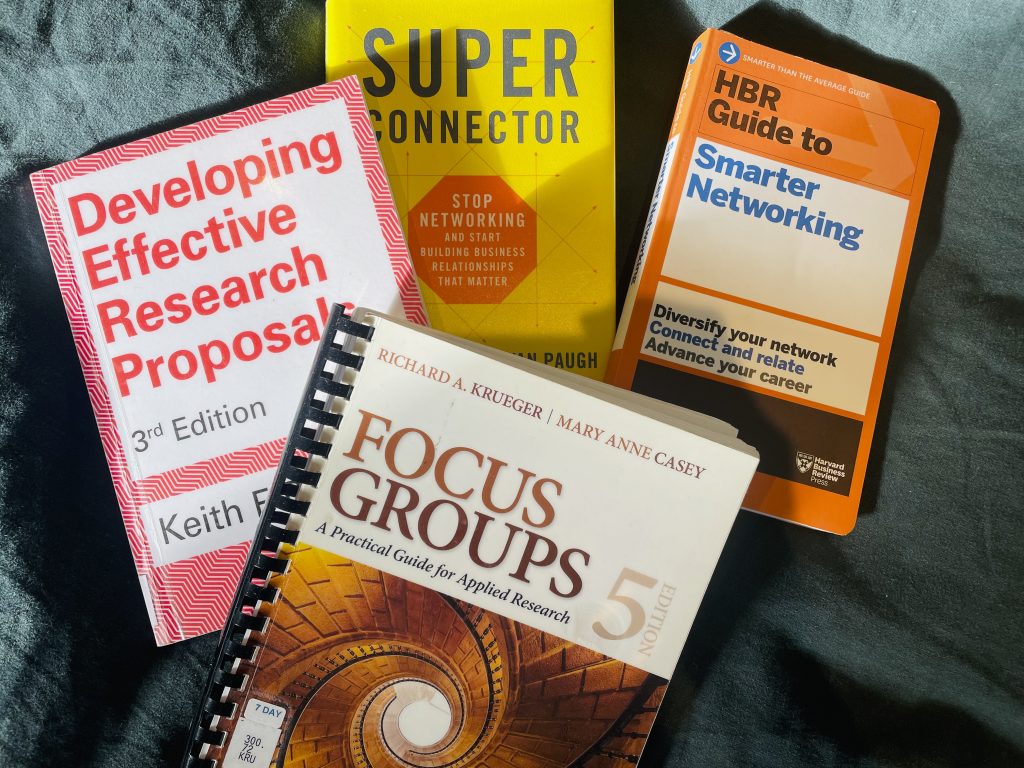
Finally, I decided to conduct a practice-based action research project in contrast to the theory-led approach I undertook here (Costello, 2003). Adapted from Harvard Business Review (2022), I have created worksheets for the students. The aim of the session will be to share insights about modern connection-building ideas and for them to engage critically, interrogating their own connections for themselves. I hope to encourage the students to become active learners by taking ownership of their future.
The worksheets feature 6 critical kinds of connections followed by a 4 step process to look at them. However, before I run the workshop, I intend to invite my colleagues to a practice round (McNiff, 2002, p. 22).