
Bell, J. (2010). Doing Your Research Project: A Guide for First-time Researchers in Education, Health and Social Science. 5th ed. Maidenhead: McGraw-Hill Open University Press, p. 30. Available at: https://www-vlebooks-com.arts.idm.oclc.org/Product/Index/155387?page=0&startBookmarkId=-1 (Accessed: 16 November 2025).
Bilgin (2021) Why positionalities matter: reflections on power hierarchy and knowledges in development research
British Educational Research Association (BERA) (2024) Ethical Guidelines for Educational Research (5th ed.). Available at: https://www.bera.ac.uk/publication/ethical-guidelines-for-educational-research-fifth-edition-2024 (Accessed: 12 November 2025).
Coulson, D., & Harvey, M. (2013). Scaffolding student reflection for experience-based learning: A framework. Teaching in Higher Education, 18(4), 401–13. https://doi.org/10.1080/13562517.2012.752726
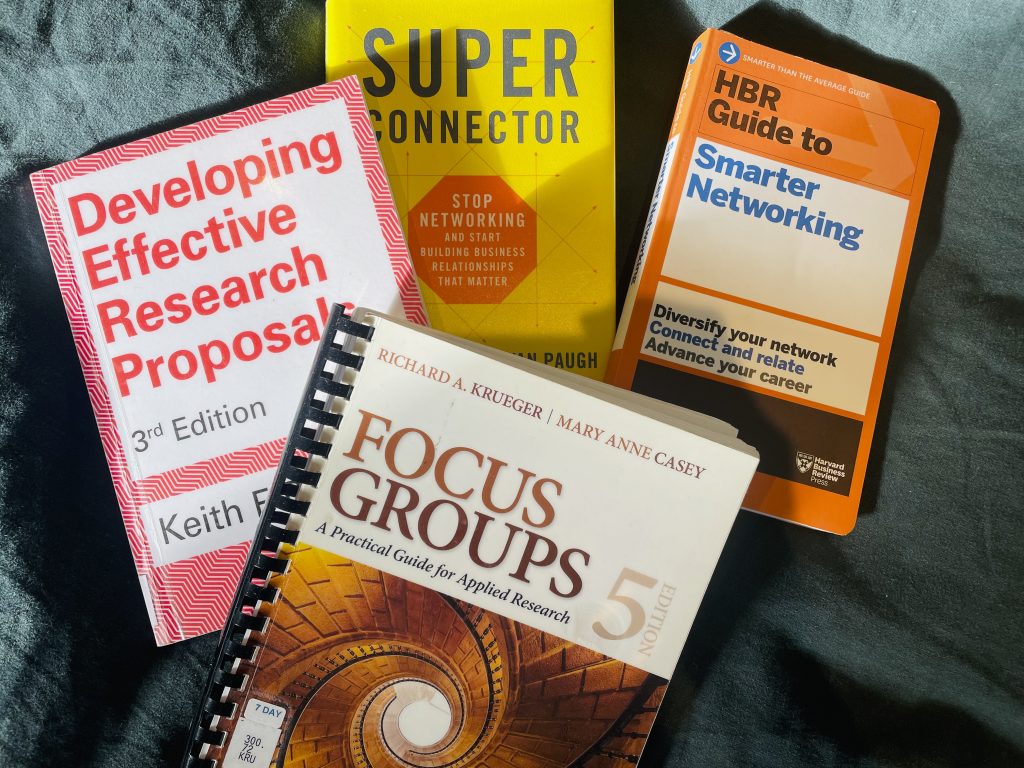
Gerber, S. and Paugh, R. (2018) SUPER connector: Stop Networking and Start Building Business Relationships That Matter. New York.
Glaser, B. and Strauss, A. (1967) The discovery of grounded theory. Chicago, IL: Aldine.
Harvard Business Review (2022) HBR Guide to Smarter Networking. Boston, MA: Harvard Business Review Press.
Harris-Reeves, B. E., Pearson, A. and Massa, H. (2025) ‘From uncertainty to clarity: A career plan task empowering first-year university students’, Journal of Teaching and Learning for Graduate Employability, 16(1), pp. 127–144. https://doi.org/10.21153/jtlge2025vol16no1art2131
Kara, H. (2015) Creative research methods in the Social Sciences: A practical guide.
Bristol: Policy Press. Chapter 6, p.100 Available at: https://ebookcentral.proquest.com/lib/ual/detail.action?docID=6193498 (Accessed:
26th December, 2025).
Kerstein, S. (2024) ‘Treating Persons as Means’, in E.N. Zalta and U. Nodelman (eds) The Stanford Encyclopedia of Philosophy. Summer 2024. Metaphysics Research Lab, Stanford University. Available at: https://plato.stanford.edu/archives/sum2024/entries/persons-means/ (Accessed: 17 November 2025).
Krueger, R.A. and Casey, M.A. (2000) Focus groups: a practical guide for applied research. Thousand Oaks, Calif., London: Sage Publications.
Punch, K.F. (2016). Developing Effective Research Proposals. 3rd ed. Los Angeles: SAGE, p. 47. ISBN 9781473916388.
Rana, R., Galligan, L., Fard, R., & McCredie, T. (2023). A novel employability embedding framework for three-year bachelor’s programs. Journal of Teaching and Learning for Graduate Employability, 14(1), 104–118. https://doi.org/10.21153/jtlge2023vol14no1art1604
Richards, A. and Reid, A. (2025) ‘Reflections on reflection: Supporting employability learning in the higher education context’, Journal of Teaching and Learning for Graduate Employability, 16(1), pp. 75–92. https://doi.org/10.21153/jtlge2025vol16no1art2062
UAL: Belonging Through Compassion (n.d.) Theory. Belonging Through Compassion. Available at: https://belongingthroughcompassion.myblog.arts.ac.uk/theory/
UAL: Creative Shift (n.d.) Connect To Creative Network. Available at: https://www.arts.ac.uk/students/student-careers/stories/creative-shift-connect-to
University of the Arts London (n.d.) Resources. In: Ethics for Making. Available at: https://ethics.arts.ac.uk/wpx/resources/ (Accessed: 12 November 2025).
University of the Arts London (2020) Code of Practice on Research Ethics. October. London: University of the Arts London. Available at: https://www.arts.ac.uk/__data/assets/pdf_file/0020/43328/UAL-Code-of-Practice-on-Research-Ethics-October-2020.pdf (Accessed: 12 November 2025).
University of the Arts London & Lotus Films (2020) Ethics for Making. Available at: https://ethics.arts.ac.uk/klynt/#Home (Accessed: 12 November 2025).
Waghid, Y. (2019). Towards a Philosophy of Caring in Higher Education. Cham: Palgrave Macmillan. https://link.springer.com/book/10.1007/978-3-030-03961-5
Reading Notes
There is debate about a new terminology to distinguish the new way of networking from the old way, in which networking was approached as to maximise its efficiency by favouring the quantity of connections over their quality, being subsequently rightfully perceived as egoistic and opportunistic. Gerber and Paugh (2018) suggest to use connection instead of connect and connecting instead of networking.
In my writing I have opted for adding descriptive words to define the new way of networking, such as meaningful, authentic, reciprocal and organically grown. This is what I am advocating for and referring to as desirable and connected to belonging. I still use networking and networks as they also have some positive associations, for instance it evokes the way we might be caught to safety by a net from a fall or an image of a network linking people together opposed to people existing in isolation. I hope, that over time with research underpinning what networks should be to help us flourish both physically and mentally, the negative connotations will diminish bit by bit.
Pictures below taken from pages in the book SUPER Connector by Gerber, S. and Paugh, R. (2018)
“Connect” and “connection” are not the same thing”
Networking […] is dead.