What are meaningful connections betweenMA Innovative Fashion Production (MA IFP) students and students from other MA courses within the School of Design and Technology, and do they increase the students’ feeling of belonging to the UAL community?
Blog Post 1: The Research Question’s Journey
I settled on this latest version of my research question because I found that by addressing this question, subsequent design for facilitating activities or learning materials can be more targeted to the students’ needs based on the findings. Further, the question is not too limiting nor has it been asked before within the stated context. Lastly, it allows to be addressed within the given time frame of the action research project. According to the ARP teaching team resource (2025), these are features, that make up a good research question.
By maintaining a curious mind about the research question, its importance highlighted by White (2009), I adjusted the research question throughout the first 7 weeks of the project until I started the question planning for the focus group, which were customised to finding a breadth of perspectives to the research question.
Initial flaw no 1
Without realising, I assumed that the students all wanted to connect to other MA students because of the question posed in the student survey. However, the student survey result does not elicit why they wanted to connect to other MA students. What I assumed was that, like me, a recent student on the same course, they would be interested to meet other MA students with a similar topic or an overlap of interest. Without knowing why, without knowing their motivation the intervention design was informed based on my own motivation and ideas of how to possibly approach it. I realised I was jumping ahead. I wanted to create a workshop with the assumption that I know what students wanted.
Initial flaw no 2
I didn’t realise that not everyone relates belonging to having a healthy network of people. For me, this was so clearly correlated based on my own life experiences that, again, I jumped ahead to assume that this link should be obvious. I was neither able to explain it well enough nor had I evidence for this claim.
This came to light when I presented my research question and rationale during the first tutorial to my academic practice peers where I was given feedback by one peer that they couldn’t see how networking relates to increasing students feeling of belonging. “How does a feeling of belonging come from a network?” They saw it as two contradictory ends, non-related.
Consequently, I reconsidered my approach. I didn’t know what my students’ ideas and thoughts about networking were. Are their preconceptions, from a student cohort of International Asian only, the same that we have in the Global West? What is their idea of a meaningful network? What do they seek? This made me think and rephrase my research question to investigating what meaningful connections are to them and what it would take for them to think back to their study time and have a sense of belonging to a student community.

References
Bell, J. (2010). Doing Your Research Project: A Guide for First-time Researchers in Education, Health and Social Science. 5th ed. Maidenhead: McGraw-Hill Open University Press, p. 30. Available at: https://www-vlebooks-com.arts.idm.oclc.org/Product/Index/155387 (Accessed: 16 November 2025).
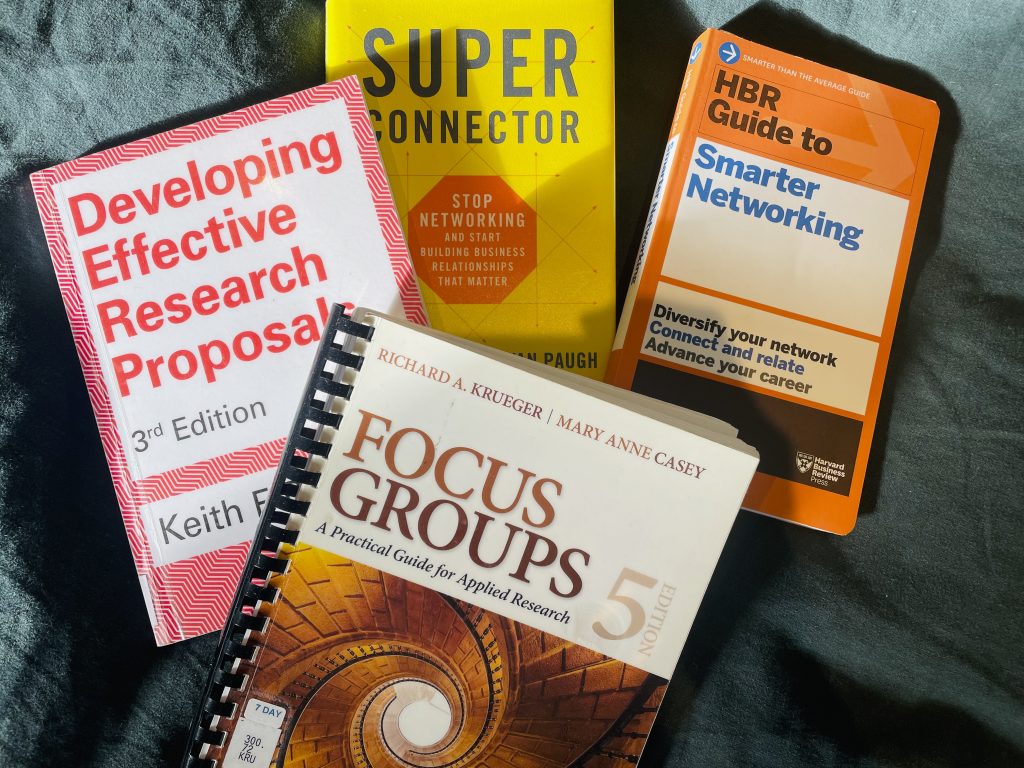
Punch, K.F. (2016). Developing Effective Research Proposals. 3rd ed. Los Angeles: SAGE, p. 47. ISBN 9781473916388.
White, P. (2009) Developing Research Questions. London: Palgrave Macmillan.
Reading Notes
Above left to right: Reading notes on Bell, J. (2010), p.30