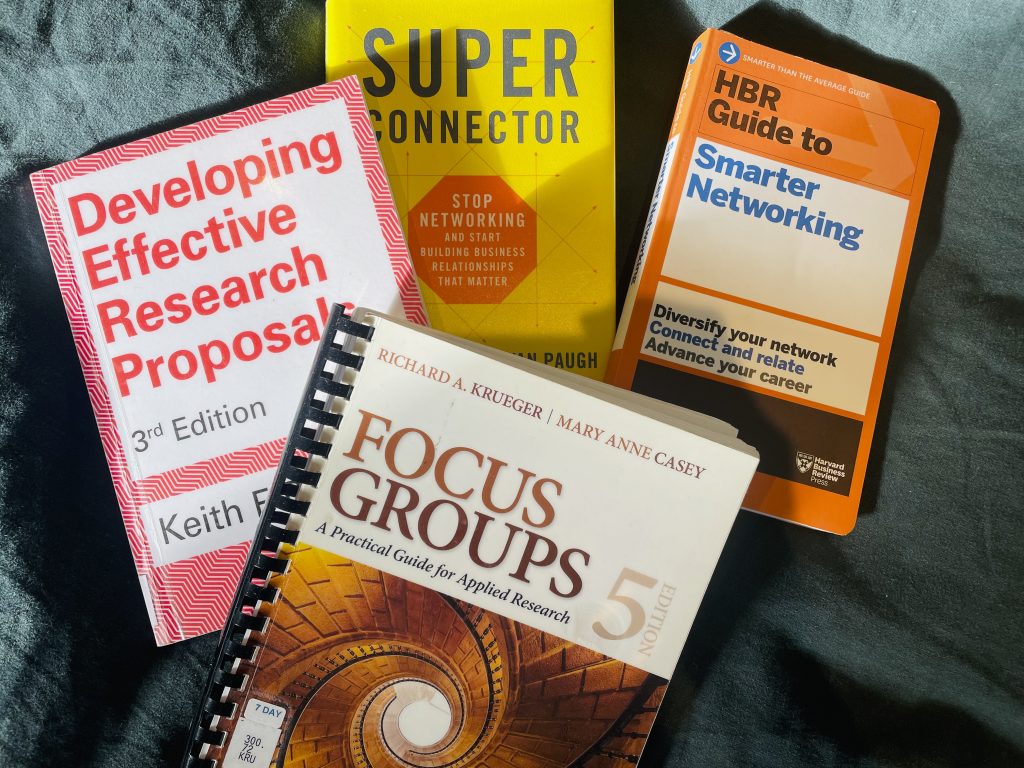
This action research project wants to find out what the needs of MA Innovative Fashion Production (MA IFP) students are to make meaningful connections to other MA students. The results should inform the development of an intervention, such as a workshop or teaching material, that aids students to identify their individual relationship-building needs. The purpose is to foster belonging and to challenge the structural and social barriers that international students, especially those arriving from Asia, might face but may not initially recognise.
Connect – You and your connections, centres students’ needs to make meaningful emotional and professional connections during their study. It responds directly to data from our Course Student Survey (CSS, 2025), where 73% of students agreed there are sufficient opportunities to connect with other postgraduate taught students. Although a figure 10% above the UAL-wide average (see fig. 1) it still leaves room for improvement.
All current MA IFP students are Chinese, far away from home, thus the groups they belong to, such as kin, culture and friends, are not in practical, immediate reach. I believe that the lack of feeling connected and consequently to belong, negatively affects academic performance and social life, triggering a cycle that can amplify individual struggles.
“Humans are hardwired with the desire to belong; belonging to family, a group of people, a community. It is existential for us now and historically.” (Eastwood, 2022).
Our core relationships, the people we choose to surround ourselves with, are our network and the place that we think of as belonging to. “Not to belong affects our physical and mental health. Even the fear of not belonging triggers a physical reaction and puts us into a fight and flight state” (Eastwood, 2022).
Unfortunately, the term networking has fallen into disrepute because the old doctrine encouraged practices that are self-serving and opportunistic, such as valuing the number of connections more than their quality (Gerber and Paugh, 2018; HBR, 2022). However, network building based on authenticity and reciprocity is not only effective for succeeding well in life, but promotes our well-being, as more recent studies suggest (HBR, 2022; Eastwood, 2022). I believe that having an authentic, meaningful, reciprocal, slowly and naturally grown network is directly related to our sense of belonging.
My positionality as a fairly recent immigrant to the UK, who has lived in multiple countries and speaks several languages, informs this perspective. I know first-hand the emotional importance of belonging and its correlation with having an authentic, supportive network, grown out of authentic curiosity and informed by reciprocal interest in one another. Truly diverse networks do not distinguish between private and professional; connections are often interlinked (i.e. multi-flex ties) and bridge across groups.

Reading notes: Super Connector by Gerber and Paugh (2018), from left to right p.1, p.2, p.9 with my annotations (2025)
Blog Post 2: Reflections on Connecting and Belonging
My topic: Connect
Here, I will pick up on the the previous post, by extending my thoughts on flaw number two, the perception gap about aligning connecting (networking) to belonging. My critical friends, or using a term McNiff (2020, p.22) offers “validation group”, were pointing out the following.
One peer said that to them, the correlation between having a network and experiencing a sense of belonging is not clear. Therefore, I’m asking myself “Why is it clear to me that networks are linked to belonging?” In addition, their association with networking were quite negative. Later, when I revisited the feedback, I recognised this from one of my readings in which the perception of them is described as “[reeking] of being inauthentic and of being manipulative” (HBR, 2022). Is there a bad and discomfortable connotation with networking? Is the connotation different for networks?
Contrarily, another peer perceived my project rationale more aligned with my intent, which they described in their words, “Allowing people to find their people”, which echoes one way I think of them. However, they continued, that initially, when they first heard about the idea in the previous unit, they also had perceived the project’s idea to be primarily career advancing.
“Allowing people to find their people“
PgCert peer (2025)
I clearly did not communicate the idea and link to sense of belonging well enough, at least not verbally. However, given my summative assessment feedback from the previous unit, I did a much better job at communicating the project in my writing, in which I was able to highlight the connection to my lived experience. Admittedly, I still struggle to bring myself in and it is not quite clear to me why exactly, maybe because I feel too exposed, too vulnerable; I fear to not express myself comprehensively and might be subject to misjudgment. Nevertheless, I will try and overcome my reservations, as I clearly see the benefit and I very much enjoy to listen to others share their personal story in connection to their work.
Lastly, my tutor wondered if I could reframe networking to be more natural and thus developing inclusivity further. He suggested to explore: Alone together by Sherry Turkle. This led to inspiring discoveries of more dimensions that I could consider, such as contemporary use of online networks versus in-person conversations and another was that reliance on peer’s advice diminishes self-reflection. What might be implications for my student group? I have started to integrate some insights, in particular, into considering the wording I use moving forward, such as ‘meaningful’ and using ‘connecting’ rather than ‘networking’(HBR, 2022).
Workshop 1 Notes
References
Harvard Business Review (2022) HBR Guide to Smarter Networking. Boston, MA: Harvard Business Review Press.
McNiff, J. (2020) ‘Action Research for Professional Development’. Available on Moodle
Turkle, S. (2011). Alone Together: Why We Expect More from Technology and Less from Each Other. New York: Basic Books