Content
- Research methodology
- Data collection tool
- Data analysis tools
- Blog post 3: Reflections about the opportunities of Focus groups
- References and reading notes
Research Methodology
The research methodology chosen for this project is an action research methodology (McNiff 2020, Costello 2003). Qualitative, iterative and reflexive. My approach to action research, from the many highly debated ones (McNiff, 2002, p.5) here is theory led (Costello, 2003) and self-reflective (McNiff, 2002, p.6). Although, the mixed approach was considered, but due to time constraints, the theory led approach dominated this unit’s strategy, for which I implemented guidance from literature alongside my reflective practice. The action research methodology embeds reflexive practice, both into my researcher-self and my work. This project draws on the works by Schön (1983), Kolb (1984), Gibbs (1988) and Rolfe (2001) for reflective writing practice. Writing and thinking (Freire) will be used to identify shortcomings of or gaps in the research question and rationale (Punch 2016; Bell, 2010). Similarly, the reflective process assists to evaluate findings and for making forward-looking plans.
After reviewing the issue in my current practice and identifying the aspect I want to investigate by defining the research question and rationale, I chose a data collection tool for trying out my “imagined way forward” (McNiff, 2002, p.10).
Data collection tool
The focus group interview is both my intervention and my data collection tool. This method was chosen because:
- I am looking for a range of opinions, perceptions and ideas about how students may connect meaningfully to other master students.
- I seek to uncover factors that influence opinions and motivation of students to want to connect to other students? *1
- I am looking out for ideas emerging from the group.
According to Krueger and Casey (2000, p.21,21), a focus group is a suitable choice for investigating the aspects listed above, such as looking for different perceptions, uncovering factors for motivation, and emerging ideas, alltogether for gathering rich qualitative data.
“A group possesses the capacity to become more than the sum of its parts, to exhibit a synergy that individuals alone don’t possess.”
(Krueger and Casey, p.22)
A focus group is a qualitative research method, in which – unlike in interviews – the conversation happens amongst the participants (Krueger and Casey, 2000, p.21/22).
The screener (a set of parameters or questions to select participants) includes current MA Innovative Fashion Production students who just started their course (Year 1). This group has a similar level of expertise which contributes to creating an environment among the students where all feel comfortable and at ease to share what they think. The session will take place on the 10th floor in the LCF canteen at the end of their day overlooking the citylights in the dark to contribute a relaxed athmosphere. I am aware that as their teacher and assessor my presence might be creating an undesirable power differential, potentially influencing their responses.
Data from reflective practice will be recorded using physical journals, my Notes app and reflective annotations in my reading notes. This data will be used for further exploration of the topic and analysis.
Data Analysis Tools
The analysis of the data from the focus group is qualitative and should be systematic, verifiable, sequential, and consequential (Krueger, R.A. and Casey, M.A., 2000, p.139).
The data analysis is purpose-driven, which means to avoid being overwhelmed by the breath of insights gained, I will identify the data that directly provide insights enlightening on the research question. A continuous analysis, a quality of focus group analysis, provides the opportunity to improve the questions and strategies for the next focus group, which in turn improves the collected data (Krueger, R.A. and Casey, M.A., 2000, p.141).
The analytical technique that will be used for coding the data is the constant comparative method, an analytical technique based on the work of Barney Glaser and Anselm Strauss (1967) cited by Krueger, R.A. and Casey, M.A., (2000, p.147). All answers to each question posed during the focus group will be analysed according to the insight gained from the response to the question. Each new inside will receive a new code. Through this method, the researcher gains an overview of the participant’s different perspectives on the topic. This is especially useful in my case, as I want to find out why students seek out what, for example, why would they like to connect to MA students from other courses.
In the next step, the coded data will be analysed and looked at for identifying themes or categories (Kara, 2015, p.100), which will then be used to produce an analytical report, the findings. For instance, themes that I anticipate to emerge as meaningful connections are friends, family and peers, like-minded or complimentary characters, maybe critical friends, that help them grow. The study is exploratory, therefore I will be mindful of moderating the focus group in the role of an observer as much as possible.
Question Design
Designed to gain insights about the research question,

Accessible and inclusive prompt design
The prompts I will use in the focus group will be shared via QR codes, allowing the participants to view the questions on their phones and to translate them into their first language. It also allows them to zoom in if they have trouble reading small text and adjusting the display mode and light if needed.
Anticipating the flow of the discussion
In addition, sharing the QR code one at a time for each question allows the participants focus on the question by not reading ahead into the following questions had they been shared together which helped me in my role as the moderator (Krueger and Casey, 2015, p.119).
Blog Post 3: Reflections about the Opportunities of Focus Groups
Through this project, I learned a lot about focus groups and one notion that stuck with me is that they seem useful for the less obvious reasons.
One of them is that they provide an opportunity for staff to connect with their students. When I ran the first focus group, I took extra care to make the students feel at ease as I was aware of the power dynamic between teacher and student. They accompanied me to the bar for ordering drinks for them and helped me set up the table with the snacks I brought. This communal activity was accompanied by casual chats, in which they shared their weekend plans, for example. For me, I could observe how close they were to one another, even though they have only got to know each other on the course 2 months ago. They huddled close, both with the two boys and amongst the girls. Soon after the session, we, the teaching team, took all 24 students to Columbia Road Christmas market for our Christmas social. My focus group then approached me with much more familiarity and warmth, picking up on chats we had before and after the session. This experience will be a future driver to consider focus groups with a secondary means to connect.
Another benefit I found is, that by foregrounding students’ perspectives and opinions, the teaching team delivers on seeking out- and including students’ voices. Other topics could be experiences, such as trips to manufacturers that we run every year.
Lastly, inviting students to focus groups role models that the use of research methods is used for real-life, tangible applications. On our course, students often neglect the importance of methodology and methods in their Masters projects, sometimes seen as an abstract thing on a tick-off list.
References
Bell, J. (2010). Doing Your Research Project: A Guide for First-time Researchers in Education, Health and Social Science. 5th ed. Maidenhead: McGraw-Hill Open University Press, p. 30. Available at: https://www-vlebooks-com.arts.idm.oclc.org/Product/Index/155387?page=0&startBookmarkId=-1 (Accessed: 16 November 2025).
Glaser, B. and Strauss, A. (1967) The discovery of grounded theory. Chicago, IL: Aldine.
Kara, H. (2015) Creative research methods in the Social Sciences: A practical guide.
Bristol: Policy Press. Chapter 6, p.100 Available at: https://ebookcentral.proquest.com/lib/ual/detail.action?docID=6193498 (Accessed:
26th December, 2025).
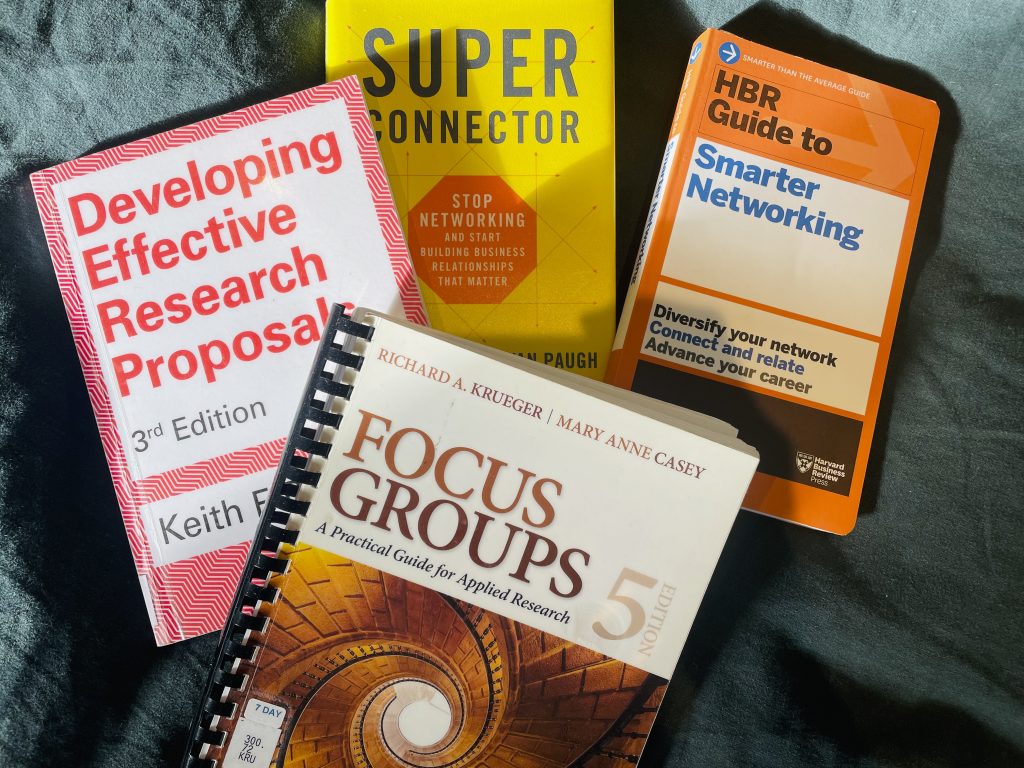
Krueger, R.A. and Casey, M.A. (2000) Focus groups: a practical guide for applied research. Thousand Oaks, Calif., London: Sage Publications.
Punch, K.F. (2016). Developing Effective Research Proposals. 3rd ed. Los Angeles: SAGE, p. 47. ISBN 9781473916388.
Reading Notes
Above reading notes: Action Research by Costello (2003), from left to right p.3, p.4, p.6 with my annotations (2025)